
In keeping with the motto of a self-reliant India (Atma Nirbhar Bharat), India has been making rapid progress in the indigenous manufacture of warships, aircraft, and defense equipment. Now the country boasts of being an exporter of Defense supplies.
India, which exports defense equipment to over 100 countries, including the USA, France, and Armenia and the countries in South East Asia and South America, recorded exports worth Rs. 23,622 crore in the Financial Year 2024-2025. Now the Defense Ministry has set an ambitious target of Rs 50,000 crore defense exports by 2029.
India’s progress in advancing expertise in Defense is proved by the recent decision to acquire a controlling stake in Sri Lanka’s Colombo Dockyard PLC for Rs.452 crore. The deal is the first international acquisition.

Ship manufacture
As part of the plan, indigenously made INS Arnala, an anti-submarine warfare shallow water craft (ASW SWC), was recently commissioned into the Indian Navy at a function held at L & T Shipyard at Kattupalli, Tamil Nadu. INS Arnala, with 80 % indigenous content, has been built jointly by the Garden Reach Shipbuilders and Engineers (GRSE), Kolkata, and Larsen and Toubro Ship Building, Tamil Nadu.
The warship is the first of the eight ASW SWCs built indigenously. The 77.6 meters long warship, is the largest Indian Naval warship propelled by a Diesel Engine-Waterjet combination. The ship designed for coastal defense and shallow water operations, displaces over 1,490 ton. The ship was commissioned into the Indian Navy on June 18. INS Arnala is named after the historic fort “Arnala” located off Vasai near Mumbai It reflects India’s rich maritime heritage.
Early this year (January) two warships- INS Nilgiri and INS Surat and a submarine- INS Vaghsheer, built entirely in India were commissioned. The stealth-capable INS Nilgiri is the flagship vessel of a new class of frigates – Project 17A – which will have seven ships and is a major evolution over the “Shivalik-class” currently in service.
Guided missile destroyer INS Surat, larger than the ”Nilgiri”, is the last ship of the “Visakhapatnam class”, which is seen as the Navy’s most powerful surface combatant. It features subsystems from Russian and Israeli warships, as well as Ukrainian. The vessel is India’s first “AI-enabled warship”.
INS Vaghsheer is the last of six new-generation, diesel-electric submarines in “the Scorpene class”, which can fire torpedoes and anti-ship missiles, meaning it can target and destroy enemies from the air and sea. The remaining ships in the series are being built at Mazagon Docks Limited, Mumbai, and the Garden Reach Ship Builders and Engineers, Kolkata. Notably, India has inducted 33 warships in the last decade and a further 62 warships, and a submarine, are being built.
Production
India’s Indigenous defense production reached up to Rs.1.27 lakh crore in the financial year 2024 (174 % growth compared to the financial year 2015) while defense exports increased by 34-fold in a decade to Rs.23,662 crore.
Private participation
The country’s Indigenous defense manufacturing ecosystem has gained unprecedented confidence through the participation of many private companies in defense production. The private sector, once a minor player, now drives innovation and delivers cutting-edge systems for modern warfare, with companies such as Tata Advanced Systems, L&T, and Adani Group expanding their portfolios and securing major contracts. Private firms now account for about 65% of defense exports.
Bharat Forge’s new manufacturing facility and its exports of advanced artillery systems underscore the sector’s growing technological prowess and export ambitions. For over a decade, Bharat Forge located at Pune in Maharashtra has established multiple capabilities in Defense manufacturing, catering to the Indian and global Armed Forces.
The Tata Advanced Systems’ agreement with “Dassault Aviation” to manufacture Rafale fighter jet fuselages in Hyderabad is another landmark. This is for the first time, Rafale fuselage production is being carried out outside France, positioning India as a key player in the global aerospace supply chain and boosting its technological capabilities.
Fighter Jets
The Indian Air Force also plans to indigenize its entire fighter jet fleet by 2042. At present IAF’s strength has been reduced to 30-odd fighter squadrons, from a sanctioned strength of 42.5 squadrons making the Government expedite pending projects like the Tejas Mk1A, Tejas Mk2, and MRFA.
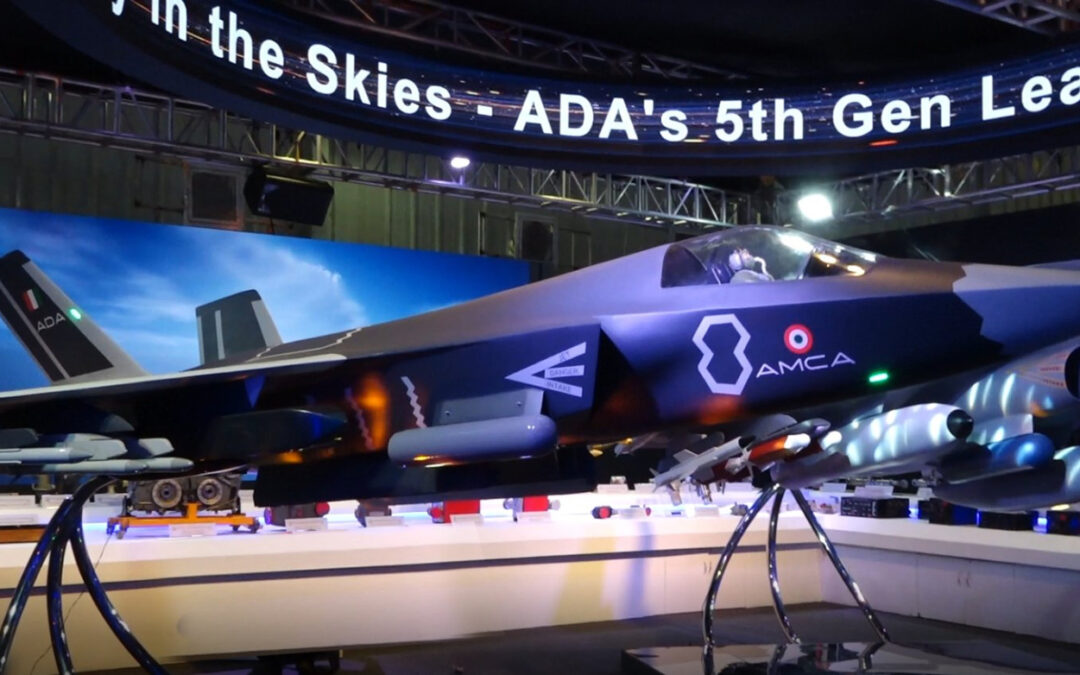
The Govt has also approved the “’Made in India” fighter jet program to produce a fifth-generation stealth fighter jet, the advanced medium combat aircraft (AMCA). The Defense Ministry has sanctioned the Aeronautical Development Agency (ADA), Bangalore, and Hindustan Aeronautics Limited-(ADL-HAL combine), to develop the aircraft from the ground up, by leapfrogging technological barriers using local resources, timelines, and control. The ADA-HAL combine aims to involve a wide consortium of public sector and private vendors like Bharat Electronics, Larsen & Toubro, and Godrej Aerospace.
The AMCA is being designed to meet specific Indian needs. Conceived as a twin-engine, 25-tonne multi-role stealth fighter, the AMCA seeks to integrate internal weapons bays, serpentine air intakes, radar-absorbent materials, AI-assisted mission systems, and sensor fusion. It is also envisioned in two variants—a Mark 1 with an imported engine (possibly General Electric’s GE F414 power pack) and a Mark II with an indigenous to-be-developed engine. Delivery of the first few prototypes is scheduled for 2035.
Related Articles
Related
World Cup winning teams felicitated by the Reliance Foundation
Mumbai: January 05, 2026: India's three cricket World Cup winning teams: men's, women's and blind women, were felicitated by the Reliance Foundation in a function organized as part of the second edition of “United in Triumph”, at “Antilia”, the residence of the...
18-foot crochet Christmas tree at Museum of Goa
By Raju VernekarPanaji: The 18-feet crochet Christmas tree stitched by 25 women with the help of a civil engineer under the bannerof the “Crochet Collective Goa” will remain for public viewing till January 18,2026, at the Museum of Goa, afterwhich the squares may be...
MoUs worth Rs 12,00,000 crore signed during India Maritime Week 2025
By Raju Vernekar Mumbai :Memorandum of Understanding (MoUs) worth Rs 12,00,000 crore were signed marking a 41% rise over Global Maritime India Summit (GMIS) 2023, during India Maritime Week 2025 held from October 27- October 31 at the Bombay Exhibition Centre, Mumbai....