
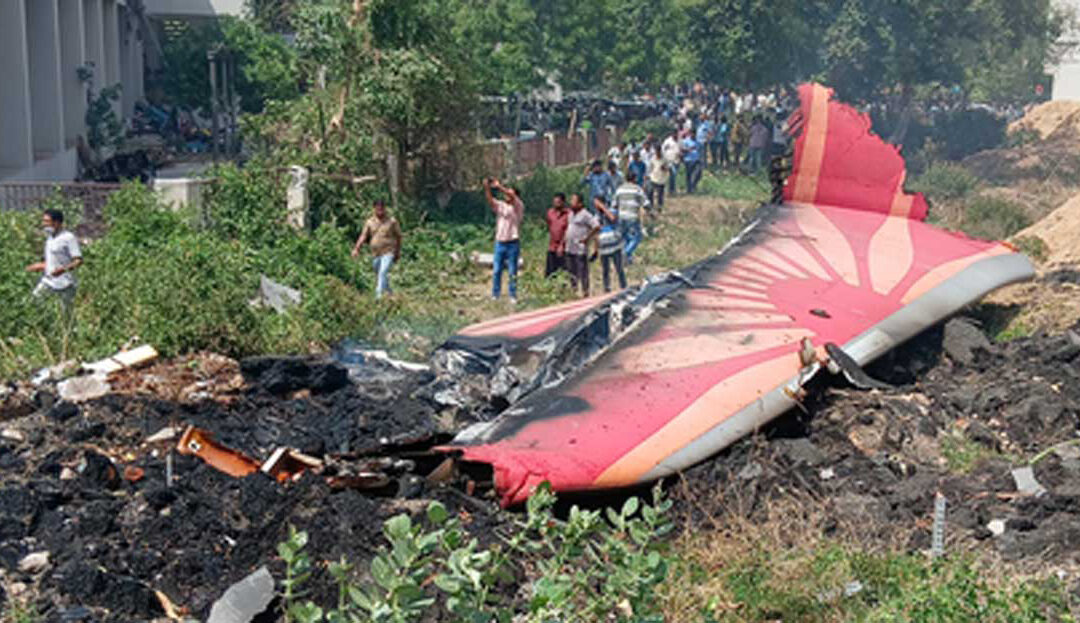
A black box of the ill-fated Air India Dreamliner retrieved.
The Black Box of the London Gatwick-bound Air India AI-171 plane that crashed in Ahmedabad on June 12,losing thrust 36 seconds after take-off and slamming into residential buildings bordering the airport, killing all 274 people, including 33 on the ground, has been recovered.
The term ‘black box’ refers to a set of two devices that record conversations between the pilots and with Air Traffic Control, as well as flight data parameters like altitude, heading, and airspeed.
All of this information is required by investigators to establish how and why a plane crashed is stored in the Cockpit Voice Recorder, or CVR, and Flight Data Recorder, or FDR.
And now that authorities investigating the Air India crash have both devices, we can unravel the final minutes, nay seconds, of AI-171 and understand why the Boeing 787-8 Dreamliner crashed.
The Civil Aviation Ministry had said that a distress call was broadcast seconds before impact. ‘Mayday, mayday…’ what Captain Sabharwal reportedly told Ahmedabad ATC. There have also been reports that Captain Sabharwal flagged the loss of power and thrust.
CVR data should reveal if he did, indeed, also say ‘… no power… no thrust…’, which will be a key piece of evidence pushing investigators to focus on the engine as the cause for the crash.
At this time, multiple theories – some ludicrous and many without adequate proof to support the claim – about what caused the plane crash are doing the rounds, including a system-wide electrical failure, possible maintenance issues, and a simultaneous bird strike in both engines.
The plane took off at 1.39 pm, the government has confirmed. Thirty-six seconds later, it crashed.
CVR data will pinpoint the exact millisecond Captain Sabharwal sent his ‘mayday’ message, which will establish just how much time First Officer Clive Kunder and he had to try and rescue the plane and the 240 other people on board, including 10 crew members.
Knowing when the ‘mayday’ call was sent will also allow investigators to work out when the problem (that caused the crash) manifested, i.e., was it present before take-off and did the pilots not notice it or did it happen after lift-off, perhaps prompted by a system failure?
Again, the CVR will also tell investigators exactly what Captain Sabharwal and First Officer Kunder said to each other and the ATC. Of course, the ATC personnel will have already been debriefed, but they may not remember everything that was said or even the tone in which it was said, which can provide clues.
And they will not know what the pilot and first officer said to each other in the plane. The CVR records all of this, as well as ambient noise from the cockpit, including that of the engine.
Crucially, ambient noise will include alarms that may have blared in the cockpit in the seconds before the crash, vibration feedback from the controllers, etc. It will also let them know how the pilots responded to these alerts.
Meanwhile, parallel to the CVR data, investigators will also have access to key flight parameters that will allow them to re-create, in real-time the flight path of the doomed Air India plane. Together, these should be able to tell us how and why this disaster happened, and how, perhaps, to ensure that such aviation tragedies are not repeated.
Related Articles
Related
Alleged misuse of foreign funds by NGOs is under the government scanner
By Raju vernekar While the new Foreign Contribution (Regulation) Amendment Rules and Bill of 2026 (FCRA Bill) have been referred to the Joint Parliament Committee (JPC) by the Lok Sabha, according to the central government, there have been instances of certain NGOs...
A mellifluous performance by “Swaranjali Plus”
By Raju Vernekar Mumbai: A program titled “Bemisal Bengal," featuring the Karaoke Hindi film songs composed by the veteran composers, including S. D. Burman, Salil Chowdhury, Hemant Kumar, R. D. Burman, and Bappi Lahiri, by the singers of different ages, including...
Maharashtra CS Reviews Coastal Security Preparedness
By Raju Vernekar Mumbai: The Indian Coast Guard (ICG) successfully conducted the Conjoined Coastal Security Exercise, “Sagar Kavach-02/26”, along the coastlines of Maharashtra and Goa from 30 September to 01 October 2026. This two-day exercise rigorously tested the...