
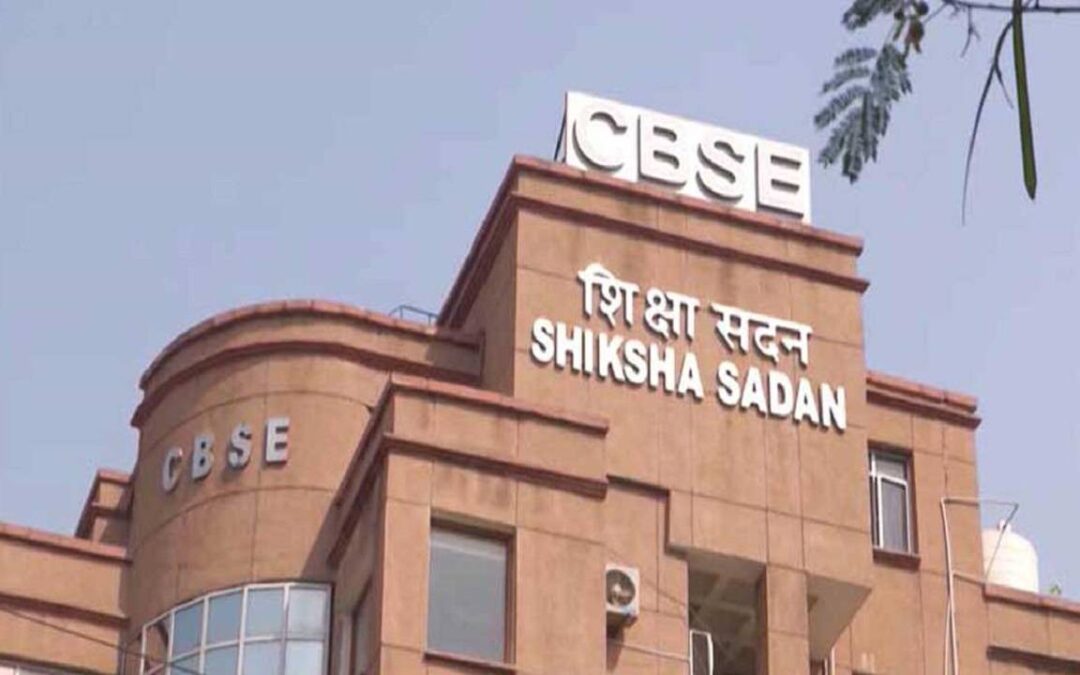
Maharashtra adopts CBSE curricula
The Marathi has been granted a status of classical language, but to equip students to face competitive examinations and make them competent on the professional front, the Maharashtra Government has adopted the curriculum of the Central Board of Secondary Education (CBSE) curriculum which has a Pan Indi appeal.
The objective behind this move is to bring quality and also allow students to learn the curriculum
Of the National Council of Educational Research and Training (NCERT). The switch over from the curriculum conducted by the state education board to new CBSE course will start from next month. So the students will step into new area.
However, the school education department has clarified that in the revised curriculum, special emphasis will be given to the subjects that highlight Maharashtra’s culture, traditions, saints, social reformers and historical figures. This is particularly why subjects such as history, geography and languages will see a curriculum developed by State Council of Educational Research and Training (SCERT), which will take NCERT as the basis but bring Maharashtra’s local context into the textbooks. Additionally, studying Marathi language in schools has been made mandatory across the state.
Now in the new academic year that began from June, Class 1 students of Maharashtra State Board of Secondary & Higher Secondary Education will have new textbooks based on the NCERT curriculum, which is primarily used by schools affiliated to the CBSE.
CBSE curriculum will be introduced for Classes 2, 3, 4, and 6 in 2026. It will be implemented for Classes 5, 7, 9, and 11 in 2027. In 2028, the final phase will be rolled out for Classes 8, 10 and 12. Curriculum creation for Classes 1 to 10 will be done through SCERT.
The CBSE schools follow a curriculum developed by the NCERT. The Maharashtra Government will follow the same curriculum for school education now. For subjects such as mathematics and science which are universal, NCERT textbooks will be replicated for state board schools. For subjects such as languages and social science among others, where local social and cultural context is required, Maharashtra’s State Council for Educational Research and Training (SCERT) will develop the syllabus. This model will be implemented in the schools affiliated to the Maharashtra State Board of Secondary & Higher Secondary Education
According to the state government’s school education department, the objective behind this move is to bring quality and also allow students to learn NCERT curriculum in schools as that is beneficial for various competitive exams for entry to coveted professional courses post Class 12.
Affiliation
The schools will continue to remain affiliated to the Maharashtra State Board of Secondary & Higher Secondary Education. This is called the CBSE model only because of use of NCERT curriculum and replication of continuous comprehensive evaluation, which is a feature of CBSE schools. It means that the schools affiliated to the State Board will now follow NCERT curriculum and evaluation patterns.
The state school education department has clarified that there is no reason to close the Maharashtra State Board, which is the unique identity of the state’s school education system having great history and culture supporting it. The state government believes that the Maharashtra State Board will be more capable of bringing new-age learning into the curriculum. SSC and HSC exams will continue to remain as it is and the Maharashtra State Board will still be responsible for conducting these exams.
Controversy
In the meanwhile, the controversy revolves around saying implementing a national-level curriculum will threaten the rich cultural history of Maharashtra of saints and social reformers, abhangs and kirtans among others, which has long been celebrated in public education through Marathi-medium schools run by the state board, along with other medium schools. However the Govt has clarified that in the revised curriculum, special emphasis will be given to the subjects that highlight Maharashtra’s culture, traditions and social reformers.
Related Articles
Related
World Cup winning teams felicitated by the Reliance Foundation
Mumbai: January 05, 2026: India's three cricket World Cup winning teams: men's, women's and blind women, were felicitated by the Reliance Foundation in a function organized as part of the second edition of “United in Triumph”, at “Antilia”, the residence of the...
18-foot crochet Christmas tree at Museum of Goa
By Raju VernekarPanaji: The 18-feet crochet Christmas tree stitched by 25 women with the help of a civil engineer under the bannerof the “Crochet Collective Goa” will remain for public viewing till January 18,2026, at the Museum of Goa, afterwhich the squares may be...
MoUs worth Rs 12,00,000 crore signed during India Maritime Week 2025
By Raju Vernekar Mumbai :Memorandum of Understanding (MoUs) worth Rs 12,00,000 crore were signed marking a 41% rise over Global Maritime India Summit (GMIS) 2023, during India Maritime Week 2025 held from October 27- October 31 at the Bombay Exhibition Centre, Mumbai....