
By Raju Vernekar
Mumbai :Memorandum of Understanding (MoUs) worth Rs 12,00,000 crore were signed marking a 41% rise over Global Maritime India Summit (GMIS) 2023, during India Maritime Week 2025 held from October 27- October 31 at the Bombay Exhibition Centre, Mumbai.
Addressing the summit the Union Minister for Ports, Shipping and Waterways, Sarbananda Sonowal, highlighted that the success reflects global confidence in India’s maritime resurgence under the leadership of Prime Minister Narendra Modi. Key MoUs included Rs. 47,000 crore (US$ 5.3 billion) green ammonia projects by V.O. Chidambaranar Port Authority Tamil Nadu) and Rs. 45,000 crore (US$ 5.08 billion) green hydrogen projects at Paradip Port (Odisha).

While addressing the summit, on October29, Modi unveiled several major initiatives under the Maritime Amrit Kaal Vision (MAKV) 2047 to expand capacity and accelerate innovation in the sector. These included the Shipping Corporation of India’s (SCI, Rs. 1,00,000 crore (US$ 11.28 billion) fleet expansion, Oil and Gas Public Sector Undertakings’ Rs. 47,800 crore (US$ 5.39 billion) shipbuilding orders, and the Green Tug Program worth Rs. 12,000 crore (US$ 1.35 billion).
IMW 2025 featured over 1,00,000 delegates, 500 exhibitors, and 350 international speakers. The event also hosted 19 thematic conferences covering digital transformation, green maritime growth, shipbuilding, and trade connectivity. With participation from 11 foreign ministers and eight Union ministers, IMW 2025 showcased India’s leadership in sustainable shipping, smart ports, and the global blue economy, advancing the nation’s vision of “Viksit Bharat 2047.”
In another development a high-impact session on “Maritime Human Capital”, was hosted by the Union Ministry of Ports, Shipping as part of the India Maritime Week 2025 It was curated by the SCI. The session focused on developing a future-ready workforce aligned with India’s vision of emerging as a leading global maritime nation. The discussions highlighted how talent, technology, and transformation will drive the next phase of growth for India’s maritime sector.
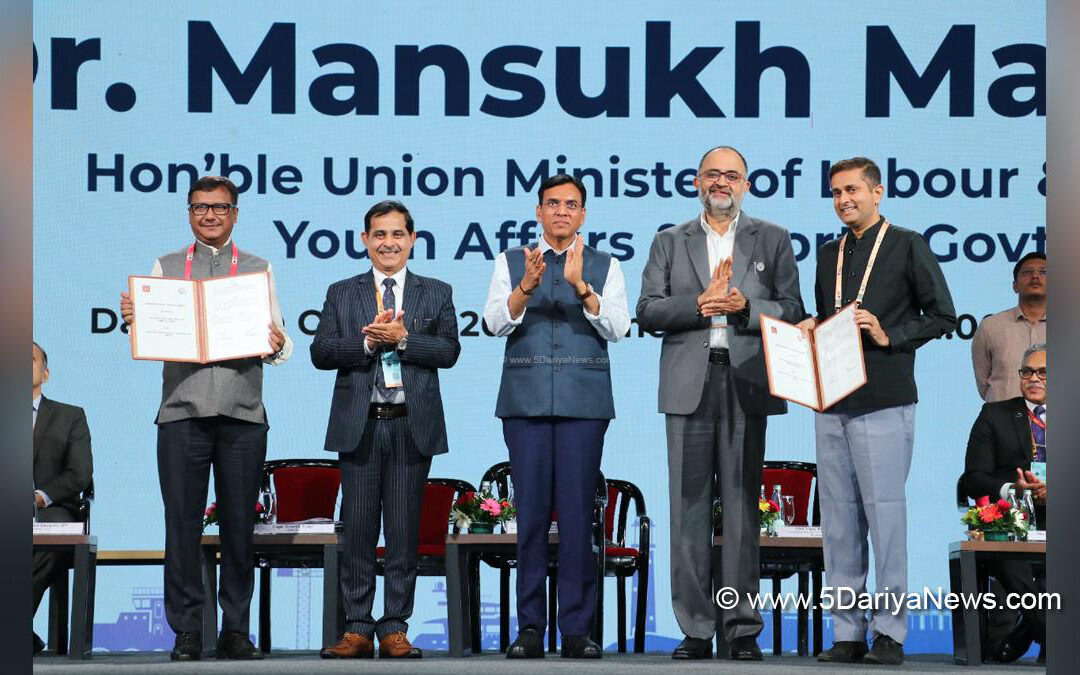
The session was chaired by Union Minister of Labor & Employment, Dr. Mansukh Mandaviya in presence of Indian Ports Association Chairman Sunil Paliwal, Director General of Shipping, Shyam Jagannathan and SCI Chairman and Managing Director, Capt. B. K. Tyagi,
In his keynote address, Mandaviya, emphasized that human capital lies at the heart of India’s maritime transformation. He highlighted the Government’s focus on skilling, upskilling, and reskilling the maritime workforce to meet global standards. He announced that the proposed National Maritime Heritage Complex at Bhavanagar in Gujarat will serve as a world-class experiential center for maritime enthusiasts, celebrating India’s seafaring history.
Dr. Mandaviya reaffirmed the Government’s objective to increase India’s share in the global
seafaring pool from 12% to 20% by 2030. With 35% of the nation’s population under 35 years
of age, he noted that India’s youth, innovation, and enterprise will steer the sector towards
realizing the vision of Viksit Bharat 2047.
Maritime human capital development
The event also witnessed the exchange of Memoranda of Understanding (MoUs) worth over
₹2,000 crore, centered on maritime human capital development
During the session, Mandaviya felicitated distinguished maritime professionals for their pioneering contributions: Capt. J. C. Anand, Founder, Indian Register of Shipping; Chief Engineer Officer Suneeti Bala, first Indian woman to serve as Chief Engineer and the nation’s first Extra First-Class Chief Engineer; Pilot Reshma Nilofer Visalakshi, India’s first woman Marine Pilot; Marine Engineer Sonali Banerjee, first Indian woman Marine Engineer licensed as Chief Engineer; and Naval Architect Parvathi Rajalakshmi, India’s first woman Naval Architect.
Welcoming the participants, Capt. B. K. Tyagi, CMD, SCI, highlighted the Government of India’s unwavering support to the maritime industry, including a four-pillar strategic approach, a cabinet-approved package worth ₹70,000 crore, and other initiatives.
Panel discussions
The first panel discussion moderated by Capt. M. P. Bhasin, Managing Director, MSC Crewing Services, explored the theme “Seafarers of the Future – Building a Modern Maritime Workforce.”
The panel comprised Sushil Mansingh Khopde, IPS, Additional Director General of Shipping, Capt. S. Panigrahi, Director (I/c), Indian Maritime University; Dr. Matthias Catón, Managing Director, German Maritime Centre; Kaushik Seal, President, IMEI; and Sunil Nair, Assistant General Secretary, NUSI.
Panellists highlighted the skills and competencies essential for tomorrow’s seafarers — including
digital literacy, green fuel management, adaptive problem-solving, and mental well-being— to
ensure readiness for emerging global challenges.
Dr. Jose Matheickal, Director, International Maritime Organization (IMO), addressed the session
on the importance of updating the Standards of Training, Certification and Watchkeeping
(STCW) to incorporate new competencies aligned with the green transition. He reaffirmed the
IMO’s commitment to enhancing collaboration with India and lauded the country’s increasing
leadership in global maritime initiatives.
The second panel discussion, moderated by Capt. S.M. Halbe, CEO, MASSA focused on “Charting Tomorrow – Talent, Technology and Transformation in Maritime Human Capital”. Panellists included Capt. S.I. Abul Kalam Azad, Nautical Advisor (Govt. of India), Minyoung Jeong, Director, KOICA, P.K. Mishra, MD, IRS, Omar Sharif, Sr. VP, DP World, Rajnish Khandelwal, CEO, JM Baxi & Co., and Krishnan Subramaniam, Int’l VP, ICS.
The panel discussed how rapid technological advances are reshaping workforce needs and capability frameworks across the maritime value chain. The session underscored India’s steadfast commitment to developing a skilled, resilient, and globally competitive maritime workforce. With a strong focus on talent, innovation, and sustainability, the Ministry of Ports, Shipping & Waterways continues to steer the nation’s journey towards Maritime Amrit Kaal.
Mumbai :Memorandum of Understanding (MoUs) worth Rs 12,00,000 crore were signed marking a 41% rise over Global Maritime India Summit (GMIS) 2023, during India Maritime Week 2025 held from October 27- October 31 at the Bombay Exhibition Centre, Mumbai.
Addressing the summit the Union Minister for Ports, Shipping and Waterways, Sarbananda Sonowal, highlighted that the success reflects global confidence in India’s maritime resurgence under the leadership of Prime Minister Narendra Modi. Key MoUs included Rs. 47,000 crore (US$ 5.3 billion) green ammonia projects by V.O. Chidambaranar Port Authority Tamil Nadu) and Rs. 45,000 crore (US$ 5.08 billion) green hydrogen projects at Paradip Port (Odisha).
While addressing the summit, on October29, Modi unveiled several major initiatives under the Maritime Amrit Kaal Vision (MAKV) 2047 to expand capacity and accelerate innovation in the sector. These included the Shipping Corporation of India’s (SCI, Rs. 1,00,000 crore (US$ 11.28 billion) fleet expansion, Oil and Gas Public Sector Undertakings’ Rs. 47,800 crore (US$ 5.39 billion) shipbuilding orders, and the Green Tug Program worth Rs. 12,000 crore (US$ 1.35 billion).
IMW 2025 featured over 1,00,000 delegates, 500 exhibitors, and 350 international speakers. The event also hosted 19 thematic conferences covering digital transformation, green maritime growth, shipbuilding, and trade connectivity. With participation from 11 foreign ministers and eight Union ministers, IMW 2025 showcased India’s leadership in sustainable shipping, smart ports, and the global blue economy, advancing the nation’s vision of “Viksit Bharat 2047.”
In another development a high-impact session on “Maritime Human Capital”, was hosted by the Union Ministry of Ports, Shipping as part of the India Maritime Week 2025 It was curated by the SCI. The session focused on developing a future-ready workforce aligned with India’s vision of emerging as a leading global maritime nation. The discussions highlighted how talent, technology, and transformation will drive the next phase of growth for India’s maritime sector.
The session was chaired by Union Minister of Labor & Employment, Dr. Mansukh Mandaviya in presence of Indian Ports Association Chairman Sunil Paliwal, Director General of Shipping, Shyam Jagannathan and SCI Chairman and Managing Director, Capt. B. K. Tyagi,
In his keynote address, Mandaviya, emphasized that human capital lies at the heart of India’s maritime transformation. He highlighted the Government’s focus on skilling, upskilling, and reskilling the maritime workforce to meet global standards. He announced that the proposed National Maritime Heritage Complex at Bhavanagar in Gujarat will serve as a world-class experiential center for maritime enthusiasts, celebrating India’s seafaring history.
Dr. Mandaviya reaffirmed the Government’s objective to increase India’s share in the global
seafaring pool from 12% to 20% by 2030. With 35% of the nation’s population under 35 years
of age, he noted that India’s youth, innovation, and enterprise will steer the sector towards
realizing the vision of Viksit Bharat 2047.
Maritime human capital development
The event also witnessed the exchange of Memoranda of Understanding (MoUs) worth over
₹2,000 crore, centered on maritime human capital development
During the session, Mandaviya felicitated distinguished maritime professionals for their pioneering contributions: Capt. J. C. Anand, Founder, Indian Register of Shipping; Chief Engineer Officer Suneeti Bala, first Indian woman to serve as Chief Engineer and the nation’s first Extra First-Class Chief Engineer; Pilot Reshma Nilofer Visalakshi, India’s first woman Marine Pilot; Marine Engineer Sonali Banerjee, first Indian woman Marine Engineer licensed as Chief Engineer; and Naval Architect Parvathi Rajalakshmi, India’s first woman Naval Architect.
Welcoming the participants, Capt. B. K. Tyagi, CMD, SCI, highlighted the Government of India’s unwavering support to the maritime industry, including a four-pillar strategic approach, a cabinet-approved package worth ₹70,000 crore, and other initiatives.
Panel discussions
The first panel discussion moderated by Capt. M. P. Bhasin, Managing Director, MSC Crewing Services, explored the theme “Seafarers of the Future – Building a Modern Maritime Workforce.”
The panel comprised Sushil Mansingh Khopde, IPS, Additional Director General of Shipping, Capt. S. Panigrahi, Director (I/c), Indian Maritime University; Dr. Matthias Catón, Managing Director, German Maritime Centre; Kaushik Seal, President, IMEI; and Sunil Nair, Assistant General Secretary, NUSI.
Panellists highlighted the skills and competencies essential for tomorrow’s seafarers — including
digital literacy, green fuel management, adaptive problem-solving, and mental well-being— to
ensure readiness for emerging global challenges.
Dr. Jose Matheickal, Director, International Maritime Organization (IMO), addressed the session
on the importance of updating the Standards of Training, Certification and Watchkeeping
(STCW) to incorporate new competencies aligned with the green transition. He reaffirmed the
IMO’s commitment to enhancing collaboration with India and lauded the country’s increasing
leadership in global maritime initiatives.
The second panel discussion, moderated by Capt. S.M. Halbe, CEO, MASSA focused on “Charting Tomorrow – Talent, Technology and Transformation in Maritime Human Capital”. Panellists included Capt. S.I. Abul Kalam Azad, Nautical Advisor (Govt. of India), Minyoung Jeong, Director, KOICA, P.K. Mishra, MD, IRS, Omar Sharif, Sr. VP, DP World, Rajnish Khandelwal, CEO, JM Baxi & Co., and Krishnan Subramaniam, Int’l VP, ICS.
The panel discussed how rapid technological advances are reshaping workforce needs and capability frameworks across the maritime value chain. The session underscored India’s steadfast commitment to developing a skilled, resilient, and globally competitive maritime workforce. With a strong focus on talent, innovation, and sustainability, the Ministry of Ports, Shipping & Waterways continues to steer the nation’s journey towards Maritime Amrit Kaal.
Related Articles
Related
Alleged misuse of foreign funds by NGOs is under the government scanner
By Raju vernekar While the new Foreign Contribution (Regulation) Amendment Rules and Bill of 2026 (FCRA Bill) have been referred to the Joint Parliament Committee (JPC) by the Lok Sabha, according to the central government, there have been instances of certain NGOs...
A mellifluous performance by “Swaranjali Plus”
By Raju Vernekar Mumbai: A program titled “Bemisal Bengal," featuring the Karaoke Hindi film songs composed by the veteran composers, including S. D. Burman, Salil Chowdhury, Hemant Kumar, R. D. Burman, and Bappi Lahiri, by the singers of different ages, including...
Maharashtra CS Reviews Coastal Security Preparedness
By Raju Vernekar Mumbai: The Indian Coast Guard (ICG) successfully conducted the Conjoined Coastal Security Exercise, “Sagar Kavach-02/26”, along the coastlines of Maharashtra and Goa from 30 September to 01 October 2026. This two-day exercise rigorously tested the...