
By Raju Vernekar
While acute water shortage in many parts of the state is annual feature during summer, an Ex Army Man Ramesh Kharmale, has created an oasis in rocky terrain of Dhamankhel Village of Junnar Taluka in Pune district of Maharashtra with dedicated labor work, giving much needed relief to the people.
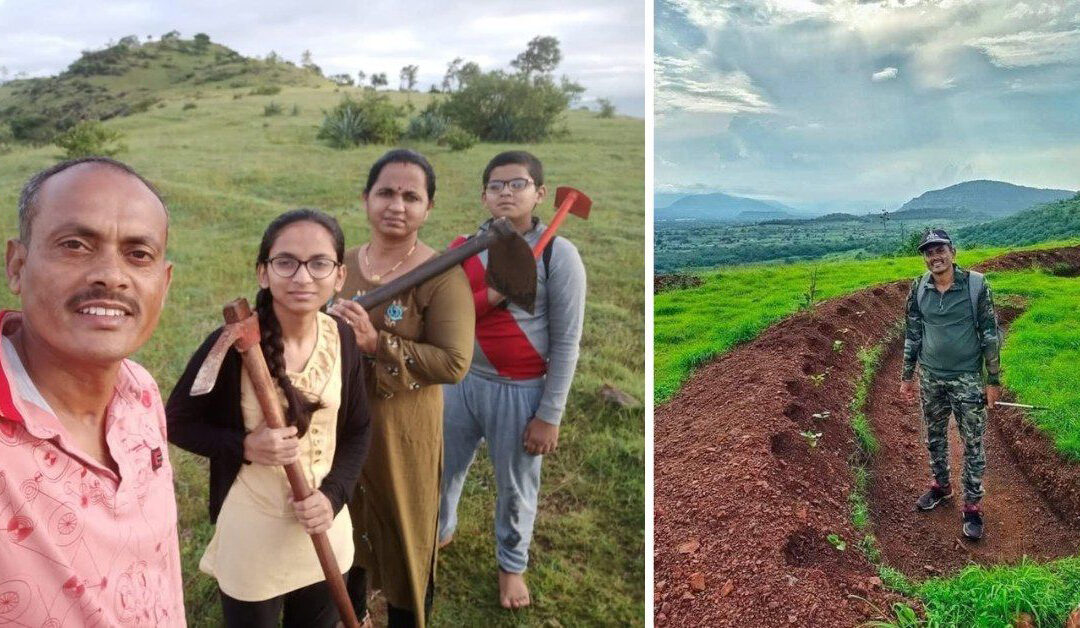
The creation of over 70 trenches equipped to store nearly 8 lakh liters of rainwater, creation of an ‘Oxygen Park’, plantation of over 600 native trees on the land belonging to the state Irrigation department, is no small achievement for Havildar Ramesh Kharmale, who retired a few years ago from the Maratha Light Infantry.
The 49 year old Havildar Kharmale who retired in 2012, after serving 17 years, initially worked as a security guard in Union Bank and then joined the Maharashtra Forest department as a forest guard.
He spends his days digging trenches on barren hills to capture rainwater, while his wife Swati cleans and restores ancient stepwells, removing weeds and giving new life to forgotten water bodies in the village. Their children, Mayuresh and Vaishnavi, join them every weekend, planting seed balls and young saplings that will one day grow into thriving forests.
Kharmale uses part of his salary which he receives from the State Forest Department and the pension received from the Army for this afforestation work. He invests R15,000–Rs 20,000 monthly from his salary to purchase saplings, seeds, and necessary equipment.
Seedballs to Plastic-Free Initiatives
Since 2013, the family has been scaling the Sahyadri hills every June to distribute seedballs ahead of the monsoon, aiding in forest regeneration. It has distributed over one lakh seeds to farmers in surrounding areas till now. They have also launched a campaign to eliminate plastic in Junnar’s tourist sites, with backing from thousands of volunteers and schoolchildren. In 2017, the family acquired a grass-cutter to prevent wildfires, a major threat to the region’s forests.
In 2021 the Kharmale family manually carved, 412 mtr long 70 contour tranches, in two months into the rocky terrain at Dhamankhel (near Khandoba Temple), a feat that now captures approximately 8 lakh litres of rainwater every season, significantly replenishing the local groundwater levels.
Oxygen Park
Kharmales have set up an Oxygen Park on 1.5 acre land in Vadaj village, located 3 km from Dhamankhel. Partnering with the Malhar Foundation, the park now features 175 native trees, including banyan, lemon, and Dalbergia sissoo. The project was executed through a community model where donors contributed directly to nurseries, and trenches were dug to facilitate growth. The family even excavated four small ponds to support local wildlife.
Contour Trenching
Kharmale applies scientific trenching methods aligned with the land’s natural contours. This technique, also utilized in regions of Telangana and Karnataka, is effective in capturing rainwater, reducing surface runoff, and enhancing groundwater levels. Local farmers have observed an increase in well water levels since these methods were introduced, and the model is now being considered for implementation in other villages.
Recognition
Their self-funded mission, which began as a quiet family initiative, gained national recognition when it was highlighted in the 123rd episode of “Mann ki Baat” radio program on June 30, 2025, by Prime Minister Narendra Modi, who praised efforts by Ramesh Kharmale and his family in rejuvenating Junnar hills.
By preventing soil erosion and creating a sanctuary for local wildlife, Kharmale has shown that military discipline can be a powerful tool for ecological restoration. His story serves as a profound reminder that individual action, fueled by family support, can heal the earth and secure a greener future for the next generation.
Every weekend, while most people slow down to rest, the Kharmale family speeds up — not with noise, but with purpose and devotion. This humble family has turned conservation into a mission of life.
Kharmale’s journey has inspired a revolution. He has visited over 400 schools, trained villagers, and turned his personal effort into a community movement. His story proves that true soldiers don’t just defend borders — they defend nature, too. Kharmale recently imparted training in water conservation to children of 579 schools in Junnar in just 60 days.
Historical research
Besides creating an environmental revolution in Junnar, Kharmale also dabbles in Historical research and has discovered ancient petroglyphs (Katal Shilpa), the underground bunkers with a tunnel-like passage in and around Junnar, dating back to the Maratha Empire. With Kharmale’s efforts, the Junnar taluka which has the historic Shivneri Fort, the birth place of Chhatrapati Shivaji Maharaj, has now been recognized as a tourist destination.
Self-Reliant Conservation Efforts
Impressively, the Kharmales do not accept external donations. Their environmental work is fueled by discipline, community involvement, and personal commitment. Their daily routine begins at 5:30 a.m. with activities related to planting and water management, continues with formal forest duties, and resumes after 5 p.m.
Kharmale exemplifies that patriotism extends beyond retirement. His military discipline, strategic foresight, and leadership have redefined service to the nation. He encourages others to “Plant four trees for your children’s future,” a message resonating throughout Maharashtra and beyond.
From the battlefield to barren landscapes, Ramesh Kharmale’s journey is a testament to hope, service, and environmental bravery. Supported by his family and a growing volunteer community, he demonstrates that one soldier, one family, and one mission can restore the land, one tree at a time. Kharmale says “I aim to create such parks in several villages to create a condusive ecological balance to improve overall life”. “Awareness is the bedrock of society. I always strive to spark a sense of responsibility among youngsters, who can bring unbelievable results”.
The infantryman wears several feathers in his hat as he actively participates in wildlife rescue operations, grass cutting, and head awareness campaigns in villages in Pune, Ahmednagar, Nashik, Satara, and Kolhapur districts.
Highly qualified family
Kharmale is B.A. B.Sc and his wife Swati is M.A. B.Ed, BSc. Daughter Vaishnavi is in the final year of B.S(Computer Science) while son Mayuresh has appeared for the SSC examination this year.
Awards
Kharmale has been honoured by “India Book of Records”, by Maharashtra Government with silver medal and by the Sainik Welfare Board. He has been bestowed with many awards including “ Sakal Sanman Puraskar”, “Zee 24 Tas Krishi Sanman”, “Vasundhara Puraskar” and “Shivneri Bhushan Puraskar” by different organizations. He was also felicitated by the National Council of Educational Research and Training, in a function organized in Shillong, Meghalaya. The Kharmale family also figured in the documentary “Couple for the Environment” produced by Educational Multimedia Research Centre of Pune University.
Related Articles
Alleged misuse of foreign funds by NGOs is under the government scanner
By Raju vernekar While the new Foreign Contribution (Regulation) Amendment Rules and Bill of 2026 (FCRA Bill) have been referred to the Joint Parliament Committee (JPC) by the Lok Sabha, according to the central government, there have been instances of certain NGOs...
A mellifluous performance by “Swaranjali Plus”
By Raju Vernekar Mumbai: A program titled “Bemisal Bengal," featuring the Karaoke Hindi film songs composed by the veteran composers, including S. D. Burman, Salil Chowdhury, Hemant Kumar, R. D. Burman, and Bappi Lahiri, by the singers of different ages, including...
Maharashtra CS Reviews Coastal Security Preparedness
By Raju Vernekar Mumbai: The Indian Coast Guard (ICG) successfully conducted the Conjoined Coastal Security Exercise, “Sagar Kavach-02/26”, along the coastlines of Maharashtra and Goa from 30 September to 01 October 2026. This two-day exercise rigorously tested the...